
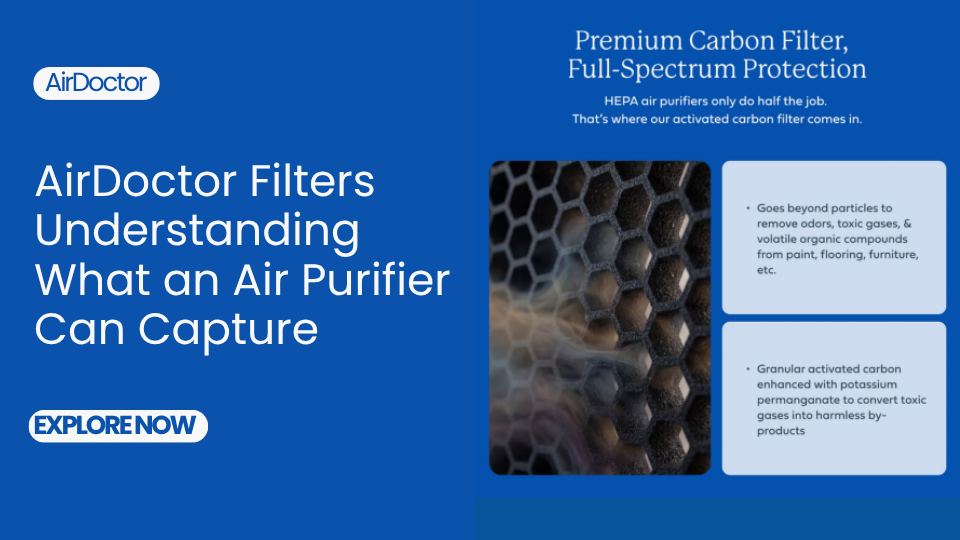
Indoor air can contain a mixture of particles and gases from everyday activities. Dust may enter through open windows, pollen can travel indoors on clothing, cooking can release airborne particles, and household products may emit gases or odors. Choosing an air purifier becomes easier when you understand which pollutants different filters are designed to address.
AirDoctor air purifiers combine multiple filtration stages intended to capture fine airborne particles and help reduce certain gases and odors. However, no single purifier removes every contaminant, and results depend on the device, filter condition, room size, and operating settings. This guide explains common indoor pollutants, how filtration technologies work, and what to check before choosing an AirDoctor model for your home.
Why Understanding Indoor Pollutants Matters
Not all indoor air contaminants behave in the same way. A filter that captures particles may not effectively remove gases, while an odor-reducing filter may not provide the same function as a high-efficiency particle filter.
Here are four common categories to understand:
- Dust and pollen: These particles can enter from outdoors or come from indoor activities. Particle filtration can help reduce their airborne concentration.
- Pet dander: Tiny particles associated with pets can circulate indoors and may be captured by an appropriately sized air purifier.
- Smoke particles: Cooking and combustion can produce fine particles that require suitable particle filtration.
- Gases and odors: Some household products, cooking activities, and other sources release gases or volatile organic compounds (VOCs). These may require a filter containing an appropriate adsorbent, such as activated carbon.
Identifying your main concern helps you choose the right combination of filtration, ventilation, and source control rather than expecting one appliance to solve every air quality problem.
How AirDoctor Filtration Works
AirDoctor uses a multi-stage filtration system, with the exact configuration depending on the purifier model. Understanding each stage helps you determine whether the product matches your priorities.
1. Pre-filter for larger particles
The pre-filter helps capture larger airborne particles before they reach the other filters. AirDoctor recommends vacuuming the pre-filter periodically, generally every couple of months, to maintain airflow. Follow the instructions for your specific model.
2. UltraHEPA filtration for fine particles
AirDoctor’s UltraHEPA filter is designed to capture very fine airborne particles. The manufacturer advertises capture of particles as small as 0.003 microns. This is a manufacturer specification, not a guarantee that the purifier eliminates all indoor pollutants or prevents health conditions.
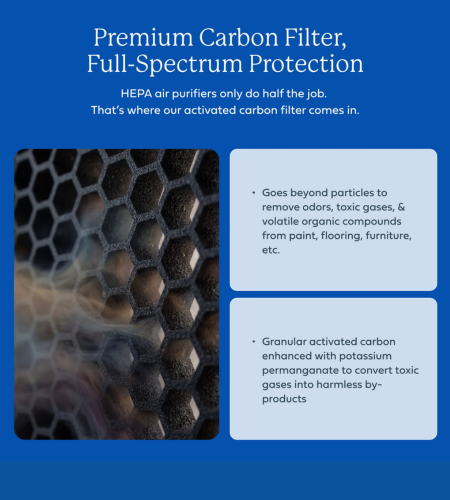
3. Carbon/VOC filtration for certain gases and odors
The Carbon/Gas Trap/VOC filter uses activated carbon combined with potassium permanganate, according to AirDoctor’s support documentation. This stage targets certain gaseous pollutants and odors. Its effectiveness depends on the substances involved, the filter design, and operating conditions.
AirDoctor
Importantly, ordinary residential air purifiers should not be relied upon to remove every gas. For example, carbon monoxide requires appropriate detection and prevention measures rather than reliance on an air purifier.
Which AirDoctor Products and Filters Should You Explore?
The official AirDoctor website provides air purifiers and model-specific replacement filters. Your choice should depend on your room size, the contaminants you want to address, and the cost of ongoing maintenance.
AirDoctor 1000
A compact model to consider when comparing air purification options for smaller spaces. Check its current coverage specifications and compatible replacement filter set.
AirDoctor 3000 series
Consider this series when comparing room coverage and separate particle and carbon/VOC filtration stages. Confirm compatibility before purchasing filters.
View replacement filters
These are examples to investigate, not a ranking. Product availability, model names, prices, and filter compatibility can change.
Filter Replacement and Long-Term Costs
Maintenance is an important part of choosing an air purifier. AirDoctor’s published guidance suggests that, under average US and Canadian home conditions with continuous operation, many models require carbon/VOC filter replacement about every six months and UltraHEPA replacement about every 12 months. Actual intervals depend on air quality and usage.
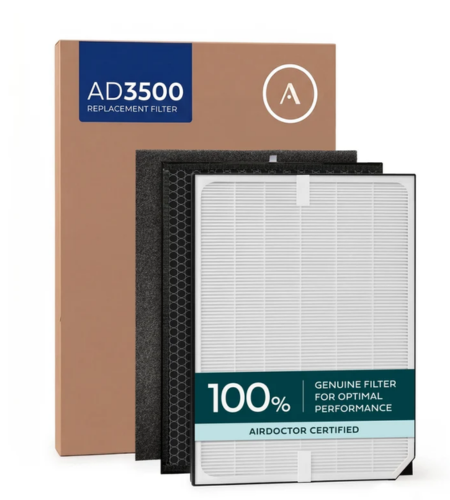
Before buying, check:
- The replacement schedule for your exact model.
- The current price of compatible filters.
- Whether individual filters or annual combo packs are available.
- The manufacturer’s instructions for cleaning and replacement.
- Whether delivery is available to your location and what shipping charges apply.
Practical Ways to Improve Indoor Air Quality
An air purifier works best as part of a broader indoor air quality plan. The US Environmental Protection Agency recommends reducing pollution sources and ventilating with clean outdoor air when appropriate, with filtration serving as a supplementary measure.
For everyday use:
- Use kitchen exhaust ventilation when cooking.
- Address leaks and dampness promptly to reduce moisture problems.
- Choose cleaning products carefully and follow their instructions.
- Keep the purifier’s air intake and outlet unobstructed.
- Operate the device at a suitable fan speed and follow its maintenance schedule.
These steps can address pollution sources that filtration alone may not resolve.
Frequently Asked Questions
1. Can an AirDoctor purifier remove dust and pollen?
Its particle filtration system is designed to capture airborne particles, including dust and pollen. Results depend on the model, room size, and operating conditions.
2. Does AirDoctor remove cooking odors?
Its carbon/VOC filtration stage targets certain gases and odors. Ventilation and removing the source of an odor remain important.
3. How often do AirDoctor filters need replacement?
Replacement intervals vary by model and usage. Check the manufacturer’s guidance and the filter indicator on your unit.
4. Can an air purifier replace ventilation?
No. Air purification complements source control and ventilation; it does not replace them.
5. How do I choose the right AirDoctor filter?
Identify your purifier’s exact model and select a compatible filter. Compare the replacement schedule and current cost before ordering.
Conclusion
Understanding indoor pollutants makes it easier to choose an air purifier based on practical needs rather than marketing claims. AirDoctor combines particle filtration with a carbon/VOC stage in applicable models, but no purifier captures every contaminant.
Compare room coverage, filter compatibility, maintenance requirements, and long-term costs before choosing. Visit the official AirDoctor store to review current models and specifications for your home.
 Harvey Glen