
Quick Facts
| Attribute | Details |
|---|---|
| Full Name | Audrey Kathleen Ruston (Hepburn-Ruston) |
| Date of Birth | May 4, 1929 |
| Date of Death | January 20, 1993 (aged 63) |
| Height | 5’7″ (1.70 m) |
| Weight | Approximately 110 lbs (50 kg) during her adult career |
| Nationality | British (born in Belgium) |
| Profession | Actress, Fashion Icon, Humanitarian |
| Estimated Net Worth | $55 million at the time of her death (equivalent to roughly $100 million today) |
Introduction: Why Audrey Hepburn Is Famous
Audrey Hepburn is celebrated as a film legend, style icon, and compassionate humanitarian. She rose to international stardom in the 1950s with her Oscar-winning performance in Roman Holiday (1953), becoming the first actress to win an Academy Award, Golden Globe, and BAFTA for the same role. Her iconic portrayals in classics like Breakfast at Tiffany’s (1961), Sabrina (1954), and My Fair Lady (1964) defined an era of cinematic elegance.
Beyond acting, Audrey Hepburn’s partnership with designer Hubert de Givenchy created some of the most memorable looks in film history, influencing fashion for generations. Later in life, she devoted herself to UNICEF as a Goodwill Ambassador, using her fame to advocate for children in need. Her life story—from surviving World War II hardships to achieving global stardom—continues to inspire millions.
Early Life and Family Background
Audrey Hepburn was born Audrey Kathleen Ruston on May 4, 1929, in Ixelles, Brussels, Belgium. Her mother, Baroness Ella van Heemstra, was a Dutch noblewoman, and her father, Joseph Victor Anthony Ruston (who later adopted the surname Hepburn-Ruston), was a British businessman with Austrian and Czech-Jewish ancestry. The family enjoyed an aristocratic lifestyle initially, dividing time between Belgium, England, and the Netherlands.
When Audrey Hepburn was just six years old, her father abandoned the family, an event that deeply affected her. With the outbreak of World War II, she and her mother moved to Arnhem in the Netherlands, believing it would be safer. Instead, they endured the Nazi occupation. Audrey Hepburn suffered severe malnutrition, eating tulip bulbs and attempting to bake bread from grass to survive. She also supported the Dutch Resistance by dancing in secret performances to raise funds and delivering messages.
These formative experiences instilled in her a lifelong empathy for those in need and a resilience that defined her character.
Education and Path to Acting
Audrey Hepburn received education in private schools across England and the Netherlands. She developed a passion for ballet from a young age, studying in Amsterdam and London after the war. Though she dreamed of becoming a prima ballerina, her height (5’7″) and the lasting effects of wartime malnutrition made it challenging. She shifted focus to acting and modeling while supporting herself with small roles and part-time work.
Her early stage appearances in London’s West End and small film roles in Europe paved the way for her Hollywood breakthrough.
Career Journey: Breakthrough Roles, Major Films, Achievements, and Awards
Audrey Hepburn’s big break came with the Broadway play Gigi (1951), which led to her casting as Princess Ann in Roman Holiday (1953) opposite Gregory Peck. The romantic comedy was a massive success, earning her the Academy Award for Best Actress. This role showcased her natural charm and established her as a star.
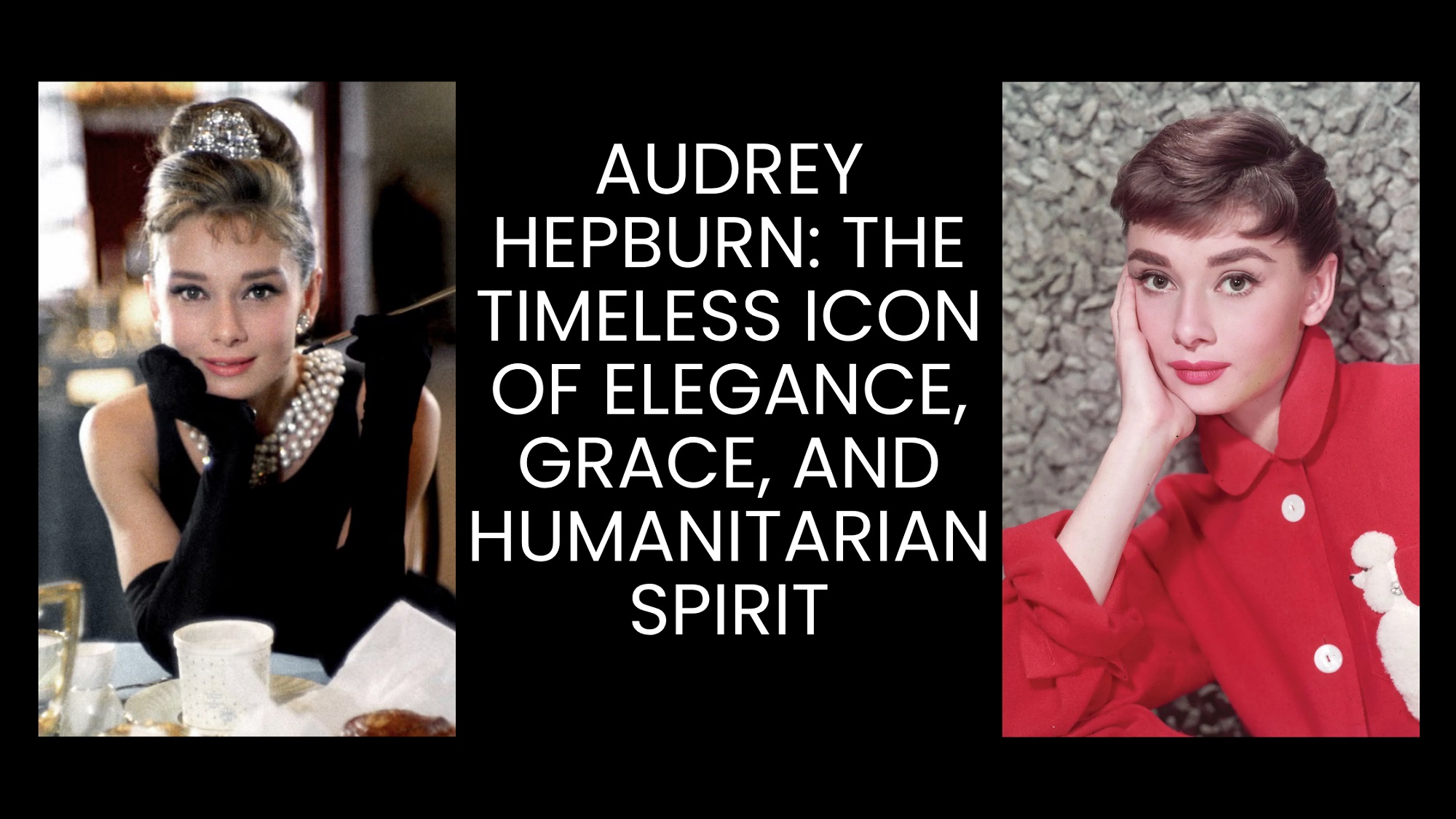
Subsequent hits included Sabrina (1954) with Humphrey Bogart, where her transformation from chauffeur’s daughter to sophisticate highlighted her versatility. Funny Face (1957) celebrated her love for fashion and dance, while Breakfast at Tiffany’s (1961) cemented her status as a cultural icon. Her portrayal of Holly Golightly, complete with the iconic Givenchy little black dress, remains unforgettable.
Other notable films include The Nun’s Story (1959), Charade (1963), My Fair Lady (1964) as Eliza Doolittle, and Wait Until Dark (1967). She received five Academy Award nominations for Best Actress and won a Tony Award for Ondine (1954) on Broadway. Audrey Hepburn also earned BAFTA Awards, Golden Globes, and is one of the few performers to achieve EGOT status (Emmy, Grammy, Oscar, Tony), with her Emmy for a 1990s documentary.
She appeared in only about 16 major films, choosing quality over quantity and retiring relatively early to focus on family and humanitarian efforts. Her style—elegant simplicity, ballet flats, and timeless silhouettes—influenced generations.
Physical Appearance and Fitness
Audrey Hepburn stood at 5’7″ (170 cm) with a slender, graceful build, typically weighing around 110 pounds (50 kg) as an adult. Her figure resulted from genetics, wartime experiences, and a healthy lifestyle rather than strict dieting. She enjoyed simple, fresh foods like pasta with tomato sauce and maintained an active routine through ballet training and gardening. Her large brown eyes, short gamine haircut, and poised demeanor defined her on-screen presence.
Personal Life, Lifestyle, and Family Details
Audrey Hepburn married twice. In 1954, she wed actor Mel Ferrer; they had a son, Sean Hepburn Ferrer (born 1960), and appeared together in films like War and Peace (1956). The marriage ended in divorce in 1968. In 1969, she married Italian psychiatrist Andrea Dotti, with whom she had a second son, Luca Dotti (born 1970). This marriage ended in 1982. From 1980 until her death, she shared a happy partnership with Dutch actor Robert Wolders.
She prioritized motherhood, often stepping back from acting. Audrey Hepburn lived a relatively private, elegant lifestyle in Switzerland at her home La Paisible, enjoying gardening, cooking, and family time. She valued simplicity and authenticity over Hollywood glamour.
Breakdown of Net Worth and Income Sources
At the time of her death in 1993, Audrey Hepburn’s estate was valued at approximately $55 million (equivalent to about $100 million in today’s dollars). Income came from high film salaries (reaching up to $1 million per project), endorsements and partnerships (notably with Givenchy), residuals from her enduring films, property investments, and personal collections of art and couture. Posthumously, licensing of her image and fashion continues to generate revenue for her estate, managed by her sons.
Interesting Facts About Audrey Hepburn
- She assisted the Dutch Resistance during WWII and suffered lasting health effects from malnutrition.
- Her father’s abandonment and family’s initial fascist sympathies contrasted with her own lifelong compassion.
- She loved pasta and simple Italian cuisine, often traveling with ingredients.
- She was an accomplished ballerina-turned-actress who walked away from stardom at its peak.
- As a UNICEF ambassador, she traveled to war-torn and famine-stricken regions, earning the Presidential Medal of Freedom in 1992.
- One of her Givenchy dresses from Breakfast at Tiffany’s sold for a record sum at auction.
FAQ
How old was Audrey Hepburn when she died? She was 63 years old at the time of her passing on January 20, 1993.
What was Audrey Hepburn’s net worth? Approximately $55 million at death (around $100 million adjusted for inflation).
What are Audrey Hepburn’s most famous works? Iconic films include Roman Holiday, Breakfast at Tiffany’s, Sabrina, Funny Face, and My Fair Lady.
What was Audrey Hepburn’s personal background? Born in Belgium to a Dutch baroness mother and British father, she survived WWII in the Netherlands before pursuing ballet and acting in London and Hollywood. She became a devoted mother and humanitarian.
Audrey Hepburn’s life was a beautiful blend of artistry and humanity—truly unforgettable.
Conclusion
Audrey Hepburn’s impact on cinema, fashion, and humanitarian causes is immeasurable. She embodied grace under pressure, turning personal hardships into a force for good. Her films continue to delight new generations, while her advocacy work highlights the power of using fame for positive change. Though she left us in 1993, Audrey Hepburn’s legacy of elegance, kindness, and resilience endures, inspiring countless people to live with authenticity and compassion. Her story reminds us that true stardom lies not just in talent, but in character.
 Harvey Glen